
Japanese culture. Among the features of Japanese culture the ritual of meal holds a special place, which replets with many nuances and complexities. So what are the rules of etiquette at a Japanese restaurant?
Of course, modern Japanese do not adhere to the rules so strictly and to the centuries-old traditions of their ancestors as well, but the rules of behavior at the table of the Japanese etiquette is much different from the Europeans’ one.
Basic rules of etiquette in a Japanese restaurant
If you are in a Japanese restaurant, you should know and respect the basic rules of etiquette.
Before you start your meal, you should wipe the face and hands with a snow-white damp cloth and only then pick up sticks and proceed directly to the food. These sticks that the Japanese themselves call “hashi” make it clear that you will eat Japanese food. In contrast to China and other countries in Southeast Asia, which also take food using sticks made of bone or plastic, Japanese sticks are slightly longer and thinner, they have pointed ends and are made of wood.
How to use hashi?
To understand, to feel the unusual feature of Japanese cuisine, its flavor, it is necessary to learn the possession of these tools. Both sticks are taken by your right hand so that one is pinched between the thumb and ring finger, emaining stationary, and the second is hold by means of the thumb, index and middle fingers. Sticks apart when the middle and index fingers and straighten and on the contrary – are connected, when the index finger is bent.

“Hashi” – it’s a tradition, the oldest national peculiarity of Japanese cuisine, so their handling is special. For example, you can not knock the sticks on the table or plate, pick or prick your food, and in any case – do not lick them. Remember that you can not put the sticks into the rice – in this variant of the meal for the dead. Highly undesirable is to clamp them in your fist – for the Japanese it is the manifestation of unfriendliness and even threatening gesture.
Japanese dishes
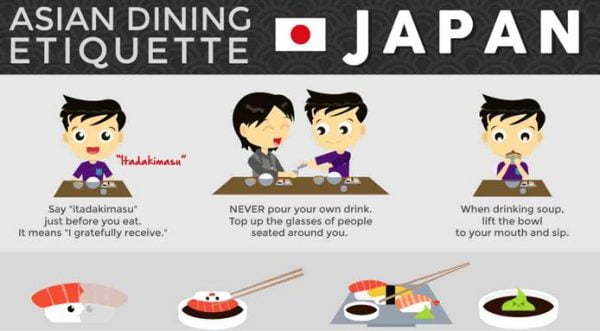
On of the most important attributes in Japanese cuisine is the dishes. It is made so that it was convenient to hold in one hand. One of the most important rules of etiquette is the following: when you drink soup or eat rice, a cup should be raised to the level of the chest. Initially you drink the broth, and then you eat the dressing with the sticks . It is necessary to observe how the meals are served. Thus, if served soup cup is covered with a lid, the cup after the meal must covered again. Occasionally Japanese use ceramic spoons for some kinds of soups or special dishes, such as “donburi.”
Rules for admission of some dishes
Due to the fact that all the dishes in Japan are traditionally exhibited on the table at the same time, there is no severe restrictions and strict sequence in taking meals.
There are certain rules for admission of some dishes. For example, eating noodles with “chopsticks”. Unlike the Europeans, it should not be wound on a stick, and immediately sucked into the mouth and chew. Naturally there is a specific “squish” sound, which the Japanese themselves do not pay any attention, considering it is quite normal.

How to eat sushi or rolls?
Sushi and rolls are eaten the whole, bathing them in a dish with soy sauce so that the fish immersed the liquid but in any case the rice. Japanese men have the privilege: they are allowed to eat sushi by hands, but the women – only with the sticks.
Eating “sashimi” and “tempura”
When eating “sashimi” (thinly sliced raw fish), add a little spicy green paste (wasabi “) to the soy sauce . Plates with sauce are held in the left hand.
Bulk food, including fried fish (“tempura”), are served on a large plate, so they are not risen up.
No Replies to "Rules of etiquette at a Japanese restaurant. What are they?"