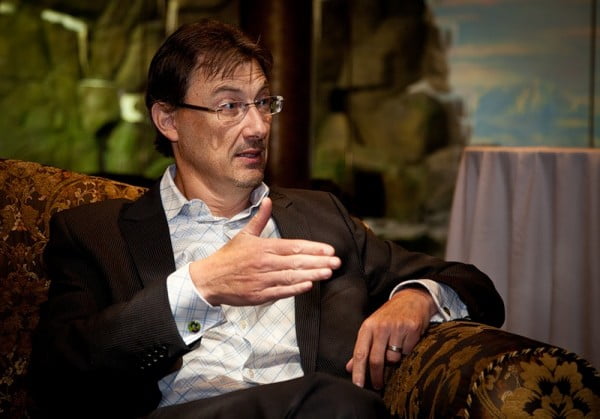
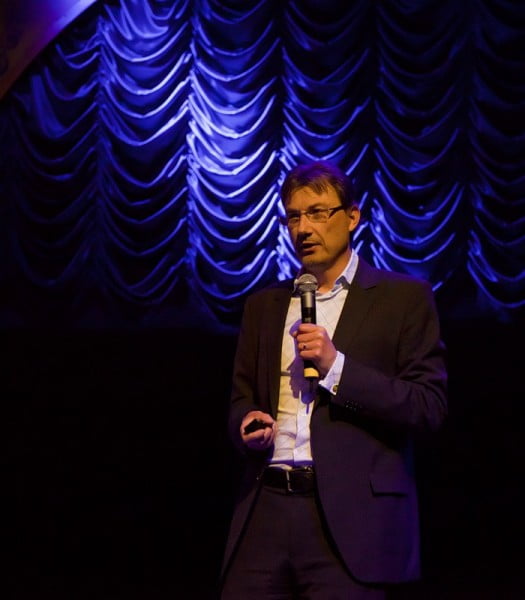
At the beginning of April in Moscow hosted a regular partner conference of Citrix, which was attended by Simon Crosby – CTO unit of cloud computing and data centers. ” Simon – a very charismatic leader, with humor describing his position as “chief religious zealot” for strategic development. He also was behind the XenServer, was technical director at the company XenSource, which in 2007 was acquired by Citrix Systems.
In a special interview for the blog Citrix Habré Simon spoke about the commitment to an open model of software development and close collaboration with Microsoft, the rivalry with VMware and the future of cloud systems. Simon – a consistent defender of the “open” model of software development, but largely do not agree with the ideas of Richard Stallman. According to Crosby, open source – it is more effective instrument of cooperation between companies and communities that are equally interested in developing an effective product. XenServer hypervisor and after passing under the wing of Citrix’s open source and, by itself, free of charge. Community participation in development can release new versions of Xen twice a year, free of charge, according to Simon – a good way to “tease” the main competitor Citrix for server virtualization.
Interview with the founder of XenSource by Simon Crosby
About XenSource
Xen was originally a project of the University of Cambridge, the work on it began in the late 90’s. Like many other academic projects, its source code was originally open. Over time, the project became popular, it began to use commercial companies that needed support. This was the reason for the formation of XenSource in 2005, and then a Xen had two major advantages. Firstly, we were open source, which was not a major competitor – VMware. Second, Xen was then the only alternative to the products of this company. But as competition in any market – it’s good we have received strong support from such companies as IBM. For example, they provided the security architecture of the hypervisor, and U.S. National Security Agency was involved in the development of the encryption module. Actively worked on the project for more than 200 programmers, and it develops very rapidly. We started with a serious backlog of VMware, but caught up with them just a year and a half.
When Citrix acquired XenSource in 2007, our market share of server virtualization is about 3-4 percent. Now we have grown to 15-16 percent. Hyper-V hypervisor from Microsoft is also rapidly gaining market share, so that now VMware has a very serious competition in the market. Although they are still in the lead, and it is they, admittedly, pretty well.
Interview with the founder of XenSource by Simon Crosby
On competition and desktop virtualization
We must understand that Citrix does not earn by selling server virtualization technology. According to the Gartner, only two products on the market ready for use in large companies, the most “serious” projects. This VMware vSphere and Citrix XenServer. We do not monetiziruem this market segment at all. Why? We believe that the virtualized infrastructure – an essential, but not the main part of our core business, desktop virtualization. To operate multiple virtual desktops naturally need a hypervisor, but it’s not the main function, just one of many.
In this case, we have technologies that allow you to deploy private and public cloud systems on the basis of XenServer. But it is not the main part of the business. In this segment, we earn more networking solutions such as Citrix NetScaler. Online business brings significant portion of income – for Citrix is about $ 300 million a year. If you go back to virtualisation desktop, I’m sure that by the end of next year we will serve millions of servers with XenServer, providing the only desktop virtualization.
We decided not to make a server virtualization for several reasons. First, historically, it is not the main activity of the company. We have great partners such as Microsoft with its System Center and Hyper-V, which provides automation infrastructure. Microsoft, like VMware, earns it, but we do differently. Citrix solutions are sold to people in the company responsible for delivering custom applications and desktops. They have always been our major clients. We just focus on the strengths of our business, and desktop virtualization, we are the undisputed leader. Over the last three quarters we virtualize more than 10 million desktops.
Interview with the founder of XenSource by Simon Crosby
About cloud computing
Any cloud system includes components Software as a Service and InfraStructure as a Service. With regard to making SaaS, we are now the fourth largest supplier in the world and we plan to further develop this area. We also develop solutions for IaaS cloud systems. We participate in the development of an open source project OpenStack, which is the only alternative to the initiative of the VMware vCloud. Our solutions work the most ambitious projects, such as RackSpace and Amazon EC2.
Through this experience, we know how to build large-scale public cloud systems. In this case we are not going to compete directly with VMware vCloud the market of private clouds. They sell the automation of IT-infrastructure. We never work in this niche, although the cost of our cloud systems are now less than 1 / 20 the cost of the same system on the decisions VMware. We can develop corporate cloud systems based on open technologies, fully automated and on a much lower price. Such systems can be used for desktop virtualization and Web application development the next generation, and we are talking not about the increasingly sophisticated IT-automation systems. We are creating a corporate cloud systems, which enable application developers – just to develop applications. No connection with IT, that’s the main difference. We are building a cloud, which provides for a single specialist at 10,000 servers. And no one in a hundred or so in the case vCloud.
There are two directions of development of cloud systems. In the first case, IT-specialists use vCloud for increasing automation. We are building a cloud-oriented developers. Everything is done specifically for developers who create applications and integrate them into cloud systems, about IT in this case is generally not a speech. Amazon EC2 does not serve the people, there is none at all.
Summarize. Our model cloud system is fully automated, is based on standard servers with local storage, lots of RAM. Cost of ownership of such a system by 60% compared with the decisions of VMware, is the cheapest infrastructure for Web applications, the next generation.
On the development of Citrix
Citrix – the fourth largest provider of SaaS, and this area is developing very rapidly, especially in European countries. Not slower growing business of virtualization desktop, much faster than server virtualization. We can say that virtualized servers are captured 30-40, perhaps 50% of the market, but the virtualization of the remaining 50% – this is a very difficult task. Virtualization technology desktop when virtual user operating system runs in a data center, appealing to 15%, perhaps – 30% of the companies. This is not enough. What to do with the remaining 70% who use “real” PC?
We have tried to answer this question by developing embedded client hypervisor XenClient. It enables virtual desktops as you connect to the network, and without it.
At the same time it provides the same degree of reliability and security of corporate data, as well as the classic virtual desktop. If a laptop with XenClient and corporate operating system is stolen, to read the encrypted data is still not succeed. If a laptop breaks, I can at any time to continue with the same copy of a virtual operating system and same data on another device. Therefore, we see great potential for growth in XenClient, inherent in it are attractive solutions for a wide range of companies – especially for those who want maximum protection of data.
Another actively developing area – these are new types of client devices, tablets, smartphones, and so on. These devices are included in the corporate environment, and there is a need for access to Windows applications from the iPhone, iPad, or something like that. In this modern tablet – it’s not a thin client, it is powerful enough processor, video system is productive. Plates were seriously affected, even to the market of classic PC, and our goal – to provide access to data, user settings and applications on any device.
About Open Source
I believe that Open Source – it is the most productive software development model. Take for instance Xen. Number of developers needed to create a truly successful hypervisor – roughly the same for us, Microsoft or VMware. Only they have to hire for that 300 people, provide them with working conditions, while they work “from start to finish, will not be released product. In the world of open source everything quite differently. Xen develop 24 hours a day, around the world, and I personally do not pay for it. Collaborative development software provides better quality of code by assessing the contribution of each member community. Thus, the quality of the code above, the development is continuously supported by most modern hardware. The finished product uses a lot of companies in a variety of tasks.
We produce a significant upgrade to XenServer twice a year. Compare with other software vendors. VMware has spent three years developing vSphere, Microsoft is usually a two-year development cycle. But we are not limited XenServer. All of our arsenal of technology cloud systems, included in the draft OpenStack, fully opened and designed community. About 200 developers from 50 different companies are working daily on this project.
From such a platform requires maximum transparency, so it should support any hypervisor to be the most scalable and ready to manage the biggest clouds. Therefore, we also added support OpenStack hypervisor ESX, Hyper-V, KVM, not counting the XenServer. This project is developing much faster than vCloud. In fact, if we estimate the rate of transformation in vSphere vCloud, we can conclude that OpenStack receive the best support solutions VMware, than he vCloud.
Interview with the founder of XenSource by Simon Crosby
Cooperation with Microsoft
We have a great relationship with Microsoft. Even in times of XenSource, we had a separate team in Redmond, who worked on the Hyper-V, we are fully responsible for the design on the side of Linux. And there was not any problems. We also added support for Hyper-V in OpenStack, and you can use Microsoft hypervisor to build a large cloud system. We productively cooperate with Microsoft in the delivery of applications. But in a world of cloud technologies, we are absolutely sure that the customer should be able to use any hypervisor. By the way, XenServer is 100 percent compatible with Hyper-V. You can take a virtual machine from the XenServer and just run it on the hypervisor, Microsoft.
We tried to avoid competition. Microsoft has System Center with comprehensive solutions for automating data centers. We do not do this, but for them it is a profitable business, they can compete in this direction with VMware. We are actively working in the field of virtualization desktop and application delivery.
No Replies to "Interview with the founder of XenSource by Simon Crosby"